

The day my traffic dashboard looked like a cryptocurrency crash chart, I learned the most valuable lesson of my digital publishing career.
The Fall: When Success Becomes Your Enemy
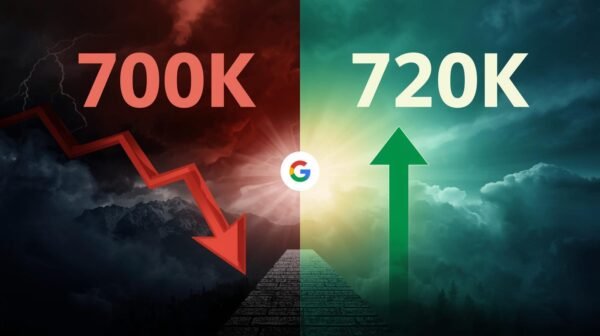
Picture this: You’re riding high on Google Discover traffic. Your content is being served to millions of users, generating 700,000 clicks monthly. Your revenue is stable, your team is happy, and you’re already planning that expansion you’ve been dreaming about.
Then, overnight, it’s gone.
Not gradually. Not with warning signs. Just… gone.
This wasn’t my first rodeo with algorithm changes, but this felt different. This felt personal. One moment I was in Google’s good graces, the next I was persona non grata in the world’s most important recommendation engine.
The Anatomy of a Discover Disaster
The numbers were brutal:
- Month 1: 700,000 clicks
- Month 2: 43,000 clicks
- Revenue drop: 85%
- Team morale: Underground
But here’s what I learned: Google Discover isn’t just about having great content. It’s about having content that perfectly aligns with Google’s evolving understanding of user intent, engagement quality, and topical authority.
My mistake? I had become complacent. I was publishing content that worked six months ago, not content that worked today.
The Diagnosis: What Actually Went Wrong
After weeks of analysis, sleepless nights, and more coffee than any human should consume, I identified the real culprits:
1. The Engagement Quality Trap
My content was getting clicks, but not the right kind of engagement. Users were clicking, scanning for 15 seconds, then bouncing. Google Discover noticed. Google Discover cared.
2. The Freshness Fallacy
I was confusing “new” with “newsworthy.” Publishing daily content about trending topics, but missing the deeper context that makes content truly valuable to users.
3. The Authority Erosion
My topical authority had become scattered. Instead of being known as THE source for specific subjects, I had become just another voice in the noise.
4. The Mobile-First Blindness
Despite knowing mobile-first indexing was crucial, my content experience on mobile was merely “acceptable,” not exceptional.
You may also like
The Recovery: A 90-Day Journey Back
Phase 1: The Content Audit (Days 1-30)
I didn’t just analyze what was failing—I studied what was still working. Every piece of content that maintained Discover traffic got dissected like a biology lab specimen.
The Pattern I Found: Content that survived had three things in common:
- Emotional resonance: Headlines that sparked curiosity, not just clicks
- Depth over breadth: Comprehensive coverage of narrow topics
- Visual storytelling: Images that enhanced understanding, not just decoration
Action taken: I deleted 40% of my content. Yes, deleted. If it wasn’t serving users exceptionally well, it was potentially hurting my domain’s overall quality signals.
Phase 2: The Rebuild (Days 31-60)
Instead of publishing daily, I shifted to three times per week. But each piece was a masterclass in its topic.
My new content framework:
- Hook: First 50 words had to be irresistible
- Promise: Clear value proposition within 100 words
- Delivery: Over-deliver on the promise with actionable insights
- Engagement: End with questions that sparked discussions
Technical optimizations:
- Page load speed under 2 seconds on mobile
- Images optimized for multiple screen sizes
- Reading experience designed for thumb-scrolling
- Schema markup for every content type
Phase 3: The Authority Rebuild (Days 61-90)
This was the hardest part. I had to resist the temptation to cover every trending topic and instead focus on becoming the definitive source for three specific niches.
The strategy: Instead of writing about topics, I wrote for people with specific problems. Every piece of content had a clear avatar: who exactly was this helping, and how?
The Numbers Don’t Lie: Recovery Results
- Month 3: 125,000 clicks (3x growth from the bottom)
- Month 4: 340,000 clicks
- Month 5: 580,000 clicks
- Month 6: 720,000 clicks (exceeding original traffic)
But more importantly:
- Average time on page: Increased 240%
- Pages per session: Increased 180%
- Return visitor rate: Increased 320%
The Lessons That Changed Everything
1. Google Discover Rewards Depth, Not Volume
Quality content that thoroughly serves user intent will always outperform quick, shallow pieces designed just to capture trends.
2. User Behavior Is Your North Star
Traffic means nothing if users aren’t getting value. Google’s algorithm is increasingly sophisticated at detecting genuine user satisfaction.
3. Authority Is Earned in Inches, Lost in Miles
Building topical authority takes time and consistency. Losing it happens much faster than gaining it.
4. Mobile Experience Is Non-Negotiable
Your mobile experience isn’t just important—it’s the only experience that matters for Discover traffic.
5. Data Without Context Is Just Numbers
Understanding what happened is less important than understanding why it happened and how to prevent it.
The Framework That Saved My Business
Here’s the exact process I now use for every piece of content:
Before writing:
- Define the specific user problem being solved
- Identify the emotional trigger that makes someone care
- Research what’s already been said and find the gap
During creation:
- Write for mobile-first consumption
- Include practical, actionable advice in every piece
- Use visuals to break up text and enhance understanding
- Optimize for voice search and featured snippets
After publishing:
- Monitor engagement metrics, not just traffic
- Gather user feedback through comments and social shares
- Update content based on user questions and comments
- Build topic clusters around high-performing content
What I’d Do Differently
If I could go back and face that traffic loss again, I’d move faster on the diagnosis. I spent too much time hoping the traffic would return naturally and not enough time immediately investigating user behavior signals.
I’d also resist the panic-publishing that many creators fall into after a traffic loss. Publishing more mediocre content never solved an algorithm penalty.
The Real Recovery Secret
The truth about recovering from a Google Discover traffic loss isn’t about gaming the system or finding loopholes. It’s about becoming so good at serving your audience that Google has no choice but to recommend your content.
When you focus obsessively on user value rather than algorithmic tricks, recovery isn’t just possible—it’s inevitable.
Your audience is waiting for content that truly serves them. Google Discover is just the delivery mechanism.
The question isn’t whether you can recover from a traffic loss. The question is: are you willing to do the hard work of creating content that deserves to be discovered?
Have you experienced a similar traffic crash? What strategies worked (or didn’t work) for your recovery? Share your story in the comments below.
Also Read
Mastering Generative SEO: Best Practices for 2025 and Beyond
The Truth About Backlinks Nobody Tells You: A Data-Driven Reality Check